Showing posts with label Norms and Nobility. Show all posts

Wednesday, November 2, 2016

Wednesday with Words: Worship and Story

I know many adults who have been moved by The Jesus Storybook Bible because it helped them understand the whole story of Scripture - every story whispers His name. I think this is part of what James K.A. Smith is hoping we will understand about worship in You Are What you Love.  One of his main points is that the form of our worship should be telling the story of the Gospel every week and inviting us into longing for the kingdom - here and in the future. He puts it this way:

He explains that worship should lead us through the "narrative arc that rehearses the story of redemption in the very form of worship".   Every week there is the call to worship (God invites us), repentance and forgiveness, hearing the word, tasting and seeing how good is the Lord and then being sent out "restor(i)ed".   Obviously, many services don't include all of these parts and may not reflect THE story- creation, incarnation, recreation (the pre-renaissance version of the Gospel) - in its form. What does the form of your worship tell you about you and God? Does your worship have the potential to "re-story" your life?  Do you allow it to "re-story" you?  Smith has lots of insights into the role of form (how we do things) in forming us as a people.

As I was reading Smith's conversation about "restory-ing" it made me think of one of my favorite lines from Norms and Nobility.
Hicks definition of mythos is not about true or false - it is a "man's imaginative and, ultimately, spiritual effort to make the world intelligible; the logos sets forth his rational attempt to do the same." Although I like the rational and ordered, I am realizing story and imagination sustain us.  I think this is one reason Charlotte Mason was such an advocate of memorizing the parables - these stories speak to us again and again in different ways as we grow.  Past generations knew the Psalms so well for similar reasons - they speak hope into difficult circumstances again and again. Do the stories my children know provide maps when they are lost?  Are they able to sustain him?

This past week I taught Daniel chapter 1 to the first graders at church.  Daniel was steeped in the stories of the Babylonians but held fast to the one true God.  They even tried to rename him - but it didn't stick - God was his judge.  In the end, this is what I want for my children.  I want them to be innocent of evil, not naive.  I want God's story of redemption and grace to be such a part of who they are that all other stories are colored by this one true story.  I desire that they recognize the hunger that cultural stories reveal and speak God's life and truth into deep pain and deep needs. An apologetics or worldview class as a teenager (the logos and analytical approach) can equip you with an argument. Are we are missing the boat though? It seems that more often we need to be armed with a loving story of truth. I think this is why many moms cry while reading The Jesus Storybook - it is restorying them and revealing who He truly is.

Want to know about re-storying a people group?  Take a listen to this older podcast by Angelina Stanford.  What she shares is incredible and the end literally sent chills up my spine.

See what other stories people are learning from at Ladydusk.


Friday, January 15, 2016

Norms and Nobility - Dialectic

This is my 4th post about Norms and Nobility and the thoughts it is stirring in me.  I am sad that I can't make the Circe Conference where David Hicks is speaking.  It's not too far away from me. Alas!

Today I want to look at his idea of dialectic.  That is a word that we often hear but may not "get". This definition gets at the crux at the issue while still being simple:

We have already seen that Socrates identified dialectic as the form of the activity of thinking - the mind's habit of challenging the thoughts and observations originating in itself or in the other minds and of engaging in a desultory dialogue with itself until the issues are resolved. (emphasis mine) 

Hicks argues that we should teach about the dialectical process because

by making his students conscious of their dialectical thinking processes . . . his students deliberately took on the dialectical form of mental activity, learning became possible.  Man could now visualize and oversee his own mind at work.  The very form of these conversations provided Socrates' students with a model for how their minds ought to work. (emphasis mine)
He is arguing that a questioning conversation is learning how to think. This reminds me of Charlotte Mason (principle #19 of her 20) who argues that one of the main things we should teach our children is what ideas to accept and reject.

Principle 19 - Therefore, children should be taught, as they become mature enough to understand such teaching, that the chief responsibility which rests on them as persons is the acceptance or rejection of ideas. To help them in this choice we give them principles of conduct, and a wide range of the knowledge fitted to them. 

Here, Hicks posits that the classical way to train people in the acceptance or rejection of ideas is through conversation and questioning.  You can see how Hicks and Mason are similar because he insists that

Classical education, therefore, cannot hope to achieve its lofty aims without laying great emphasis on the development of the conscience in the student.  The emphasis begins, as we have seen, in the normative study of myth, from which the dogma of the Ideal Type emerges. 
Hicks, by this point in the book, has clearly defined what he means by the formative power of myth.   In CM she discusses laying a banquet of the best thoughts, through literature, before our students to help inform their thinking.

When we hear "dogma" we associate it with an unthinking acceptance of someone else's truth.  In our culture it is seen as a problem.  However, Hicks is arguing it is fundamental to good thinking.  It isn't created by a list of rules; but rather, by a gathering of stories and ideas passed down through culture that informs our decision making. He asserts:
Dogma is to dialectic what doubt is to analysis: one cannot begin the one without the other. 
Dialectical learning requires that he accept a dogma before he rejects it. 
To truly engage in learning we need to have a firm belief in something and be willing to question it. We need to be involved in these issues and seek resolution for them - this is not just mental assent - this is transformational belief.  So what is the role of a teacher?

The connection between dogma and dialectic defines the master-pupil relationship.  The master's life displays what it means to accept and to live by a dogma, and the pupil's imitative acceptance of his teacher's dogma affords him an insight into his own life and studies that eventually corroborates, refines or invalidates the dogma.  
See - imitation again!  They are watching us (mentor, teacher, parent) to see what dogma we really live by and if it "works".  This is why being a teacher or parent is such a weighty role!  We know they are watching and we are constantly falling short of what we believe.  It leads to a life of constant repentance!  We are afraid that our life is "invalidating" our dogma.  Is it??

Finally, these comments help put dogma back into it's proper place.
Dogma, from the Greek meaning - "that which seems good" - are his (the student's) hypothesis. 
Once he receives a dogma, the student of dialectic begins in his life and learning to verify it. 
We must help our students form a firm "hypothesis" about what the good life is through story and example when they are young.  As they grow, we need to allow them time, questions, conversations and help them to discover if their dogma or hypothesis is really true. They need to read the stories of the good, the bad and the ugly to help them think about these characters and ask those big questions. Dialectic is the process of thoughtful questioning that leads to a firm conscience; not blind acceptance, but hard won truth.

My kids are still young so we are still "forming dogma" while trying to avoid preaching.  Giving them stories of truth, beauty and goodness to develop their appetite.  I am pretty sure we will be in for a wild ride once our oldest really starts questioning (more) but I need to remember that this is the way he is learning and the only way it can become his own truth "which seems good" - not just "mom says".

There are no promises, but I need to be faithful to my part of sharing and living what "seems good" in front of all my children and teaching them how to question and therefore think so that they can verify this "good life" on their own.

Monday, December 14, 2015

Norms and Nobility: Leisure Misspent

Much of the talk around education these days is about rest and leisure. I have not yet read Leisure as the Basis of Culture - but I intend to soon.  David Hicks explains it this way in Norms and Nobility.

Indeed, the theoretic life, is the life of virtue, so long as we mean by virtue all that the Greek arete expresses: the life that knows and reveres, speculates and acts upon the Good, that loves and re-produces the Beautiful, and that pursues excellence and moderation in all things. 
The life of virtue  has nothing to do with one's prospective pleasures, possessions or practical affairs, but concerns the manner in which one is prepared to spend one's leisure hours. 
Predictably, as science took a technological turn and as education began to preparing students for work rather than for leisure, for the factory rather than the parlor, the school itself came to resemble the factory, losing its idiosyncratic, intimate and moral character. 
The 1828 Dictionary 

Leisure - Freedom from occupation or business; vacant time; time free from employment  

Entertainment - Provisions of the table; hence also, a feast; a superb dinner or supper. The amusement, pleasure or instruction, derived from conversation, discourse, argument, oratory, music, dramatic performances, etc.; the pleasure which the mind receives from any thing interesting, and which holds or arrests the attention. 

Amusement - entertainment of the mind, pastime; a pleasurable occupation of the senses, or that which furnishes it, as dancing, sports or music

Today's dictionary

Leisure - free time, use of free time for enjoyment 

Entertainment - the action of providing or being provided with amusement or enjoyment.

Amusement - the state or experience of finding something funny.

I highlighted the "from employment" and "for enjoyment" because it gets at the crux of the difference. Rest from employment was the point of leisure in the past and there were a variety of ways that could be spent.  Today, the definition tells us that leisure is "for enjoyment" which many of us equate with amusement and entertainment.  In some ways,leisure today is defined as a selfish thing, in the past it wasn't so clear how you were to use it.  You'll also note that entertainment and leisure in the 1828 dictionary include a strong relational element, engaged the mind and required attention. However, our age has a whole different type of amusement that does not require any of these things of its participants,  

Hick's work and these definitions point out two key ideas to me.

Leisure calls you to a decision

I have conflated leisure and amusement in my mind, they need to be separated.  Free time (leisure) does not have to lead to amusement - it can lead to enjoying beauty and goodness through the arts. The way that Hicks describes art and virtue working together in the first quote.  However, as I share the the arts  - visual, music, drama, and literature -  my children view them as WORK (because it is school time) not LEISURE.  They see things that are amusing - Minecraft, Splatoon, Super Why, - as the proper use of their free time (leisure). I need to redefine these activities as amusement and the other as culture creation - but both are FREE TIME (leisure) activities.  By not fully understanding how to use (and that I can choose to use) my family's leisure time well - my children are "Amusing Themselves to Death" (another book I haven't read but would like to).

Even though the arts are not "extra" in educating my children, I have not taught them how this is to be pursued as leisure and not work.  To enjoy a book, painting, good discussion or piece of music will require some work - but it should be a restorative, fulfilling work. Leisure allows a choice - something that builds culture and character or amusement and entertainment. I need to practice making better choices and helping my children to do likewise.

Leisure time (not work) as an indication of Virtue

If, as Hicks suggests, how we use our free time demonstrates our virtue; then we have LOTS of work to do around here (mom and dad included).  Are my free time choices cultivating my mind and the culture of my home or are they hollow entertainment and amusement?  Am I attending to culture making for myself and my family during my leisure time?  This issue is humbling me!  I don't think I have really thought about how much choice I have in this issue. I know I have not taught my kids to be discerning in this area.  I think this issue of using your free time is like looking at your spending habits - how you do it truly shows your priorities,  That is helpful to me - especially as I start thinking about "New Year's resolutions" and planning.

Since my education was geared towards work, I have always thought of how I do my "work" as the key to showing virtue.  However, Hicks and classical thinkers turn that on its head.  Not that you should act unethically in your work, but rather that willing yourself to do what is right when you have freedom (of time) shows who you are and what you value.

We don't fall into the "school as factory" model that Hicks describes, but I think we have been following a different subtle and destructive path.  We have believed that our children need and deserve some amusement - they empty kind - because they are kids. This ties in with Hick's discussion of whether we are preparing them to be adults or are "child centered"?  By allowing my children to spend their free time in amusement I am not cultivating culture or character in them.

I needed to name these concepts and now I think I can better understand that we do "spend" our free time (leisure)- the choice is either in culture creating activities or amusement.  If preparing students to use their leisure time wisely is the aim of classical education maybe I should stop undermining my own efforts!  

Wednesday, December 9, 2015

Norms and Nobility: 2 Questions


I am glad to be back thinking about Wednesday with Words again.


I have started reflecting on ideas and passages in Norms and Nobility by David Hicks.   My last post talked about a story formed life being a classical approach.


Today, I want to look at this striking quote.
In his quest for the best education, the ancient schoolmaster possessed two advantages over the modern educator.  First, he knew exactly what kind of person he wished to produce. . . Second, he agreed in form upon an inquiry-based or knowledge-centered - as opposed to child-centered - approach to education.  Whether he was a philosopher hoping to elicit knowledge or a rhetorician hoping to implant it he ignored the "child" and appealed directly to the "father of the man" within his student. 
Much of this chapter is dedicated to "what kind of person" the Ideal Type would produce.  The fact that our culture doesn't have an "ideal type"is telling.  Honestly, this quote caused a bit of a problem for me because it spoke to the root of my issue.  What am I trying to produce?  I do think it is my job to plant and leave the "production" up to the child in relationship with God.  But my "ideal type" will focus my planting efforts.  What am I planting? Why?

It helped me realize that I am still caught between the "American education" system ideal and the Christian ideal type (Jesus) and they are NOT the same.  Maybe, in some mythical past, they had some similarities but today they are very different.  I am at the point where a clear choice must be made and I have not wanted to decide (remembering the root for that is kill).  The time has come - one vision must die.  I need to burn my old yoke and submit to the new.

I also thought I had gotten over the "child-centered" approach to education.  His discussion made me realize I was falling short.  He asserts

The healthy child wants to become an adult, just as the mature adult wants to be an adult. 

Well, I am not sure that is true of our society.  So, even what seems like a basic assumption is going against the grain.  The work required to call children into adulthood is not built into our educational approach any longer.  We marvel at the colonials as they regularly took on large responsibilities in their late teens.  There are many reasons, beyond this discussion, why this is no longer, but I don't think our essential nature has changed - societal expectation and preparation has.
Of towering importance to the child are not the playful, innocent moments remembered by an adult who nears death, but the hard-won progress he makes as a child toward his image of adulthood.  He measures his greatest achievements and most agonizing defeats against this image.  When his teacher holds out to him only an image of how 12-year-olds ought to think and act, his hope of growth wavers, and he becomes restive and inattentive. 
Guilty!  I am guilty of making excuses based on age, personality, learning type, gender, whatever. Instead of constantly pointing them ahead towards what they are called to become, I make excuses so they don't have to do the hard stuff.  In part, because at home, I have to deal with the attitude, tears, frustration.  I must have a clear vision of maturity that I call myself to and hold out as an example for my children.  My indecision is killing the wrong thing - without vision, people perish.


Saturday, December 5, 2015

Norms and Nobility: Story Formed

As I consider David Hick’s work Norms and Nobility, I do not intend to trace his argument for you. Instead, I want to highlight a few ideas that encourage me to further consider my teaching and my children’s education.  The first is his idea of the formative power of mythos or story.  

Earlier this year, I read Ministry of Motherhood with a group of moms.  If you follow Sally Clarkson (Own Your Life) and Sarah, her daughter (Caught up in a Story), you might be familiar with this idea of a story formed life (listen more on RAR). 

I think it is essential that we realize that this is not NEW; in fact, Hicks argues it is the basis of a true Classical education.  

The mythos (story) represents man’s imaginative and ultimately spiritual effort to make this world intelligible; the logos sets forth his rational attempt to do the same.  

and 

A good myth, like a good map, enables the wanderer to survive, perhaps even flourish, in the wilderness.  

Are the stories in your home equipping your children to survive in the wilderness?

This idea of story isn’t about writing your story for empowering or even re-writing it for the sake of healing.  These are two popular trends in understanding and using story today and there is value in them.  However, Hicks calls us to a use of story that is more fundamental than that - mythos creates an Ideal Type that lays an outline for behavior, action and attitude.  

If Hicks is arguing that this is the basis to Classical education, why does this seem so novel?  Is there a proper way to use story in this formative way?  We need to reclaim this tool of learning for ourselves and our children.

Story is essential to a "good" grammar stage


Currently, when many of us think of the “grammar” stage or grammar within the trivium it can be boiled down to memorization and facts. Kids can remember a lot of things so lets take advantage of it! I was reminded as I went through the 5 Elements of a Classical Homeschool course of this much more fitting definition from The Liberal Arts Tradition.  

Consider, for example, what a reader should know in order to properly interpret The Aeneid, and one will intuitively grasp the nature of grammar in its classical sense.  

When I heard this I thought of the muses playing together.  That is the point; and they call this stage "musical education" in the Liberal Arts Tradition for that exact reason.  Stratford Caldecott, in Beauty in the Word, calls it remembering.  Memory is the mother of all the muses.  For me, this wider definition of grammar is freeing. We are learning facts and information so that we better understand the story - the story is the point!

Story is not optional or extra, it is essential to who we are.  As Andrew Kern frequently points out, God, our creator, gave us many stories and then the law.  He created us to learn from story and example. So, if grammar is really about stories, how do we do it well?

Which stories

As Christians our ideal type is Jesus. So, how do we present Him to our children. 

Traditionally, Christians memorized the Psalms - it was the song book of faith. It reflects many Biblical stories and shows how we pray and interact with God. Its serves as a template and many Psalms point towards Christ.  Many of them aren't pretty and show the anguish and struggle of faith - something our kids need to know about.

Charlotte Mason encourages us to memorize the parables.  Why would that be?  She understood the role of stories. Knowing a parable can speak to us over and again - sometimes we are the prodigal son and sometimes the older brother.  The story calls us to reflect and can be a “map” when we are wandering. Jesus spoke in many parables but he only explained one. In our current age, we often try to memorize random, key verses (often with a head knowledge but no heart) and apply them like band aids. Band aids haven't yet healed a wound.

She also encourages that children be read the Gospels over and over again. This testifies to her faith in seeing Jesus as He is, in Scripture, as enough to instruct them in what the Christian ideal type is. Often we add extra, good things (catechisms, adaptations, object lessons) but fail to do the one essential thing - read the Word. This has challenged me to just read it to my kids chapter by chapter (maybe I'll even do what Dwane Thomas suggests and have us listen to it in Latin as well)!    

Additionally, in a standard Mason curriculum, Plutarch and Shakespeare, in the original, are introduced in 4th grade.  To our current mindset this doesn’t fit.  We aren’t sure what to do with these stories - aren’t they above our kids?  They can’t possibly analyze them well.  All the better, because they are included, not for comprehension, but for formation and maybe even transformation.  I checked out a book on Plutarch’s educational philosophy but ran out of time to read it - I intend to get it back (I’m not too concerned that anyone else out there cares).  Plutarch literally wrote the classical book on Ideal Types. Shakespeare's works provide us with a wealth of characters - fictional and real - that can inform our lives. By setting Ideal Types in our child’s mind we are calling them to enter into the possible and giving them examples of ideals in action.

We don’t bat an eye about giving children the definition of courage and then asking them to follow it up with copywork (maybe even a Bible verse).  How much better to read a real story (not a contrived one) about someone who was courageous (or not)? Which will you remember longer?  We have eliminated story as a legitimate educational tool because you can't measure the impact of a story. Fortunately, we can show you that they clearly know the definition and even wrote it out! You have to decide which is more meaningful to you and your child in the long run.  

Teaching the story

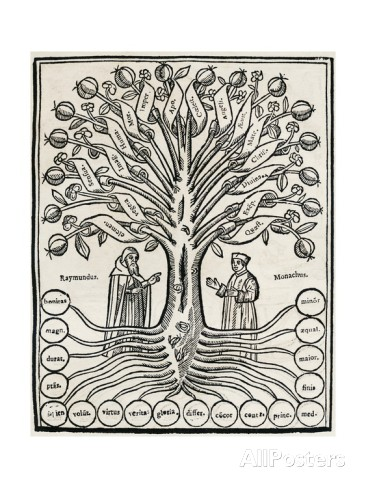
Before I started re-reading Norms and Nobility I decided our house needed more artwork.   Here are two that I picked out: Norman Rockwell - Age of Romance, Llull - The Tree of Science:
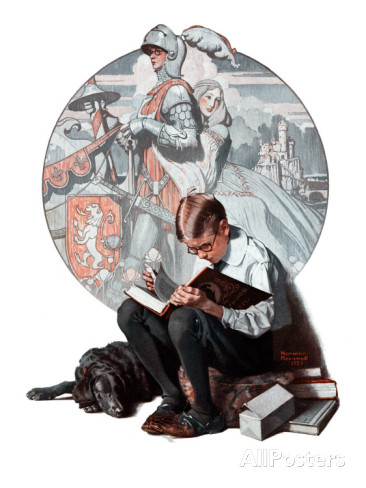
and

I now see how these two represent different ways to approach story.  The first is the classical way - imagining you are in the story, a part of it, submitting yourself to its influence.  The second is more analytical - it is a virtue tree from the middle ages.  It is trying to help logically illustrate and analyze parts to make a whole.  It's much like using a plot outline from day one to "enjoy" a story. I like what Hicks says

myth defies analysis, especially in instruction, and happily usually survives it.

There is something to knowing the plot outline of a story but that doesn’t bring us closer to the Truth.  When I was in 6th grade I went to see Field of Dreams and I was caught up in analyzing the mystery of it all. I saw it again and realized I had missed the whole point.  By analyzing it, I missed the relationship.

How do we draw children into the story so it can help form them?

First, I think of the power of narration. Retelling brings them into the story and makes them think about it.  However, this natural interaction allows the relationship to develop between the child and the story without outside expectations or interference (read comprehension questions).

Second, do your kids play the story? Young children naturally become St. George or whoever they are reading about. Watch them and see what they are learning by the way they are playing. Older kids will play with stories in different ways - telling jokes, quoting lines, using it in their writing and conversation, etc.

Third, the art of questioning. There are a few key questions (none original to me but some I can’t exactly trace):

Andrew Kern’s favorite (explained by Buck Holler) - Should (this character) have done (this action)? 
ex: Should Martin Luther have burned the papal bull?  
What other (character or situation) does this call to mind or remind you of?
ex. Do Charlotte’s actions remind you of another character or person?
Do you see (virtuous attribute) in this story?  
ex.  Do you see honor in this story?
How is this (character or situation) like (another character or situation)?
ex. How is Ebenezer Scrooge like Donald Trump?

With young children I would use these basic questions, as students get older using the five common topics (this blog post is a wonderful example) can go a long way. See how these questions draw the reader into the story and ask for analogic answers.  These are life long learning questions that will yield fruitful analogies, deep conversation and bread if you end up as a “wanderer” in the wilderness.  

Children will naturally wonder if they have what it takes to be like the Ideal Types that they hear about. Are they hearing about someone worth being like?

Although I have heard about mythos, story, as fundamental to forming character, and really the point of education, for quite a while, I just couldn't grasp it. I was thinking analytically - lets break it into chunks and work on these parts. Good stories are analogies and dissection leads to death; much like explaining a good joke, ruins it. They are meant to be received whole and often speak to us in ways that we can’t articulate.  We need to let that be okay in us and in our children.  The fruit we want is a life well lived, not a momentary answer well crafted.

I hope my children say “Once upon a time in a story I . . .”